Meet the Developer. Own the IP. No Lock-In.
Hire Shopify Developers you actually get to meet first.
Hire Shopify developers on a fixed-price project or a dedicated monthly allocation. You meet the developer before committing, the work lives in a repository you own, the IP transfers to you on payment, and a dedicated engagement ends on notice rather than a contract you have to argue your way out of.
You can hire Shopify developers two ways: project-based, where a defined scope is quoted at a fixed price and the estimation risk sits with the supplier, or as a dedicated monthly allocation, which suits a continuous roadmap. Meeting the developer before committing is the single best predictor of how it goes.
★★★★★5.0 rating on the Shopify Partner DirectoryBuilding on Shopify since 2016



How to judge one
The pitch team and the delivery team should be the same people.
The most common complaint about hiring developers through an agency is that the senior who ran the sales call is never seen again, and the work is done by someone quieter and more junior. It is such a standard pattern that most buyers have stopped asking about it.
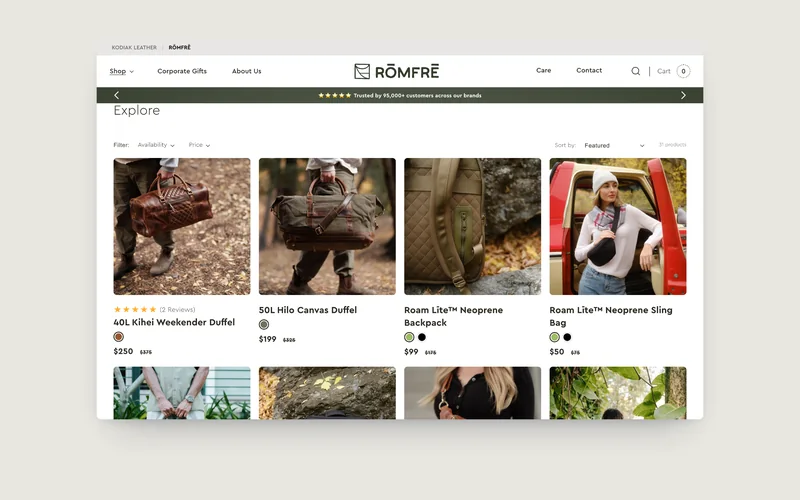
Ask us. You meet the developer who will do the work before you pay anything, every project is owned by someone who has shipped Shopify stores end to end, and if the fit is wrong we replace them or end the engagement rather than holding you to it. What that work looks like in practice is on our portfolio page.

What we do
What you can hire us to build.
Custom Shopify Development
Liquid, Online Store 2.0 sections, metaobjects and custom storefront logic for DTC, B2B and hybrid businesses.
Shopify Plus Development
Checkout Extensibility, Shopify Functions, native B2B and Shopify Markets for brands selling across borders.
Custom Theme Development
Bespoke Liquid themes built from scratch. Mobile-first, merchant-editable through section schema, Lighthouse 90+.
Platform Migrations
WooCommerce, Magento and BigCommerce to Shopify. Redirect mapping built before cutover so rankings survive.
Shopify App Development
Private and public apps built to App Store standards: OAuth, verified webhooks, privacy endpoints and Polaris UI.
ERP Integration
Shopify to Odoo and Shopify to ERP sync for inventory, orders and customers, with real error recovery.
Where we work
Worldwide delivery, local pricing and payments.
The build standard does not change by market. What changes is the currency you are quoted in, the payment gateways and carriers we configure, and the hours we schedule against.
Shopify Experts New Zealand
Local pricing in NZD, regional payment gateways and carriers configured, and delivery scheduled against your business hours.
Shopify Experts Australia
Local pricing in AUD, regional payment gateways and carriers configured, and delivery scheduled against your business hours.
Shopify Experts United States
Local pricing in USD, regional payment gateways and carriers configured, and delivery scheduled against your business hours.
Shopify Experts United Kingdom
Local pricing in GBP, regional payment gateways and carriers configured, and delivery scheduled against your business hours.
Shopify Experts Canada
Local pricing in CAD, regional payment gateways and carriers configured, and delivery scheduled against your business hours.
Hire Shopify Developers: common questions
How do I hire Shopify developers through you?
Send the store URL, what you need built and roughly what you want to spend. You get a written response with an honest read on scope, a fixed-price range and a timeline, usually within a couple of business days. If it is a fit we run a scoping call, then a written proposal. There is no discovery fee and no obligation to proceed.
Do you offer dedicated developers or project-based work?
Both. Project-based is a defined scope at a fixed price, which is what most merchants want and where the risk sits with us rather than you. A dedicated developer is a reserved allocation of a developer's time each month, which suits businesses with a continuous roadmap rather than a single project. We will tell you which one actually fits what you have described.
What are your rates?
We quote projects at a fixed price rather than by the hour, because an hourly rate transfers estimation risk to you and rewards the slower supplier. For reference, a small fix starts at USD 49, a starter build runs USD 899 to 3,500, a fully custom theme USD 3,500 to 12,000, and enterprise or Shopify Plus work starts at USD 15,000. Dedicated developer allocations and retainers are quoted monthly, starting at USD 450 a month.
Can we hire a developer part-time?
Yes. A part-time allocation, typically a set number of days a month, works well when you have a steady stream of changes but not enough to justify a full-time hire. You get the same named developer each month rather than whoever is free, because continuity is most of the value in that arrangement.
How quickly can a developer start?
Usually within one to three weeks, depending on the size of the engagement and what is already booked. Urgent remediation on a broken or underperforming store we will generally look at sooner. We would rather give you a real start date than promise tomorrow and stack you behind existing commitments.
Can we speak to the developer before committing?
Yes, and we encourage it. You should meet the person who will do the work before you pay for it. What you will not get is a polished senior in the sales call and a different, quieter person on the project afterwards.
Who owns the intellectual property?
You do, completely, on payment. The store sits on your Shopify account, the theme code is yours, custom apps are transferred to you, and there is no license fee to keep using what we built. We retain no claim over the work and we do not resell a client's custom build to the next client.
Do you sign NDAs and formal contracts?
Yes to both. An NDA before commercially sensitive detail is shared, and a written agreement covering scope, price, milestones, IP ownership and confidentiality before work starts. If your legal team has a preferred agreement we will work from yours.
What if the developer is not the right fit?
Tell us early and we replace them or end the engagement, depending on which you want. For a dedicated allocation there is a notice period, but we will not hold you to months of a relationship that is not working. A bad fit caught in week two is a scheduling problem; the same fit tolerated for a quarter is an expensive one.
What happens during leave or absence?
Work is in a shared repository with written documentation rather than in one person's head, so a second developer can pick up a project without a two-week rediscovery phase. For longer planned absence you get notice and a named cover. This is one of the concrete differences between an agency and a single freelancer.
How do you handle communication across time zones?
We schedule against your working hours, not ours. Written updates land daily so progress is visible without a meeting, and there is a fixed weekly slot in your time zone for anything that needs discussion. Urgent issues have a direct channel rather than a ticket queue.
Can your developers work in our tools?
Yes. Jira, Linear, Asana, Trello, Slack, Teams, GitHub, GitLab or Bitbucket. We adopt your workflow rather than asking you to adopt ours, and we join your stand-ups where that is how your team runs. The exception is code review standards, which we hold to regardless of whose repository it is.
Do you do team augmentation alongside our in-house developers?
Yes. We can take a defined workstream, review your team's pull requests, or be the senior escalation point for a junior in-house team. The one thing we insist on is a clear boundary on who owns which part of the codebase, because shared ownership without that boundary is how two competent teams produce one broken store.
What seniority of developer do we get?
Senior. Every project is owned by a developer who has shipped Shopify stores end to end, with specialists brought in for design, app or integration work. We do not staff a project with a junior and supervise them at your expense, which is a common agency model and the reason a lot of agency work is slower than it should be.
Is there a minimum engagement?
Not for project work. A focused piece of work is a legitimate project and we quote it honestly rather than inflating it to meet a minimum. Dedicated developer allocations have a one-month minimum simply because anything shorter does not repay the ramp-up for either side.
How is work tracked and invoiced?
Project work is invoiced against milestones you can see delivered on the staging link. Retainers and dedicated allocations are invoiced monthly with a written summary of what the time went on. You will not receive an invoice for work you have not been able to look at first.
How is this different from hiring on a freelancer marketplace?
Marketplaces are cheaper per hour and genuinely fine for a contained task with a clear definition of done. The differences that matter are continuity when someone is unavailable, accountability for the seams between design, code and data, and a written scope you can hold someone to. If your job really is one contained task, a marketplace may be the better call and we will say so.
What do we need to provide?
Store access, your product data in whatever state it is actually in, brand assets, and one named decision maker. Content is the dependency that delays projects most often, so if copy and photography are not ready, say so at the start and we will plan the schedule around it rather than discovering it in week six.
Related
Looking for something more specific?
Further reading
Guides worth your time.
- Best Shopify Experts in Australia and New Zealand, ranked and reviewed
- What Shopify development actually costs, with real project ranges
- Shopify vs Magento: which platform fits which business
- Shopify store security and bot protection, what merchants miss
- Shop Pay Installments and what it does to conversion
- Running rentals on Shopify: the Booqable alternative
















Tell us what you are building.
Send the store URL and what you want to change. You get a written response with an honest read on scope, a fixed-price range and a timeline. No discovery fee, no obligation.