
Answers written from your own store
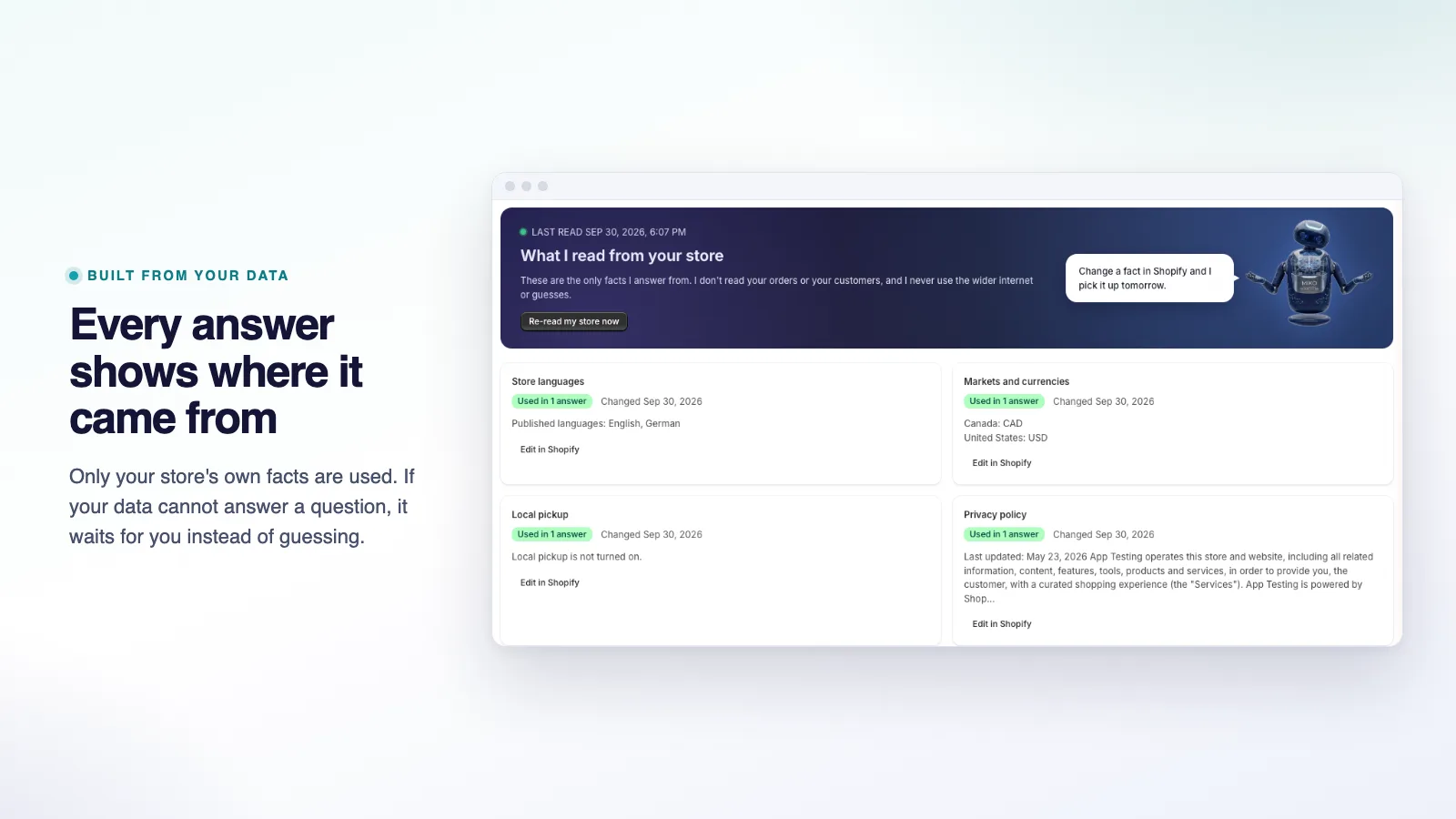
Shipping, policies, pickup and markets, read directly from your store and turned into clear answers.
 Miko AI Help Center & FAQLive on the Shopify App Store
Miko AI Help Center & FAQ is the tenth app in our own Shopify suite, designed and written here in Auckland. This is the build note: where the brief came from, which parts were genuinely difficult, and what solving them says about the work we can do inside your store.
Plans, screens and settings live on the Miko product page. There is a free plan, and paid plans start at $9.99 a month with a 14-day free trial.
 Miko AI Help Center & FAQ
Why merchants install it
Shipping, policies, pickup and markets, read directly from your store and turned into clear answers.

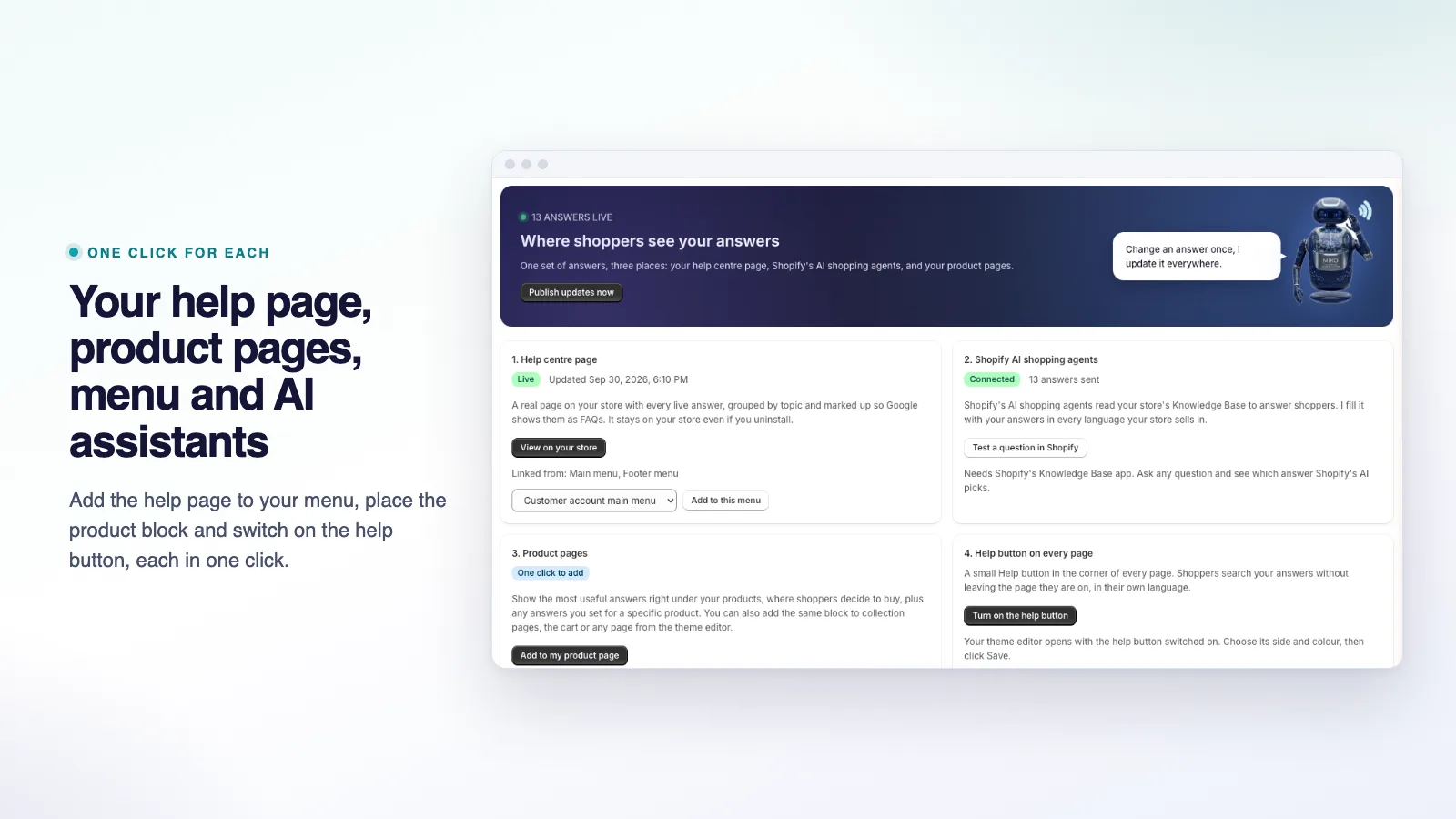
A help centre page, product page FAQs, and the Shopify Knowledge Base that AI shopping assistants read.

Answers are flagged out of date the moment your store changes, so nothing goes stale quietly.
How it works
Add Miko AI Help Center & FAQ from the Shopify App Store. No credit card required.
Miko reads your shipping, policies, pickup, markets and existing FAQs, and drafts answers.
Approve the answers, publish the help centre page, and sync to the Shopify Knowledge Base.
Pricing
$0
$9.99/month
$19.99/month
$39.99/month
Paid plans include a 14-day free trial. Prices in USD, billed through Shopify.
The build story
01The Brief
Across the stores we support, a recurring pattern kept showing up: a handful of shipping and policy questions accounted for most of the support inbox, and the FAQ page that should have stopped them was either missing, out of date, or written once and never revisited. At the same time, Shopify started building a Knowledge Base that AI shopping assistants read directly, and a store with no accurate answers in it was invisible to that layer by default.
The obvious shortcut was to point a language model at the store and let it invent a plausible FAQ. We rejected that early. An FAQ is only useful if a merchant can trust it, and a generic AI-written page erodes that trust the first time it is wrong about a real policy.
02The Hard Parts
None of these are visible in a feature list. All three are the reason the app is safe to publish straight to a storefront.
03What This Proves
If your business needs AI-assisted content that has to stay accurate as the underlying facts change, the work is the shape above. Reading a system of record correctly, tracing generated content back to its source so it can be checked, and detecting staleness at the fact level rather than re-processing everything on a timer. We have those three in production, under load, with our own name on the support inbox.
Full detail, every screen and the plans are on the Miko AI Help Center & FAQ product page.
04From The Build
Interface work on a content tool is mostly about proof. Where did this answer come from, and what happens when it stops being true.
FAQ
Tripster Developers, a Shopify agency in Auckland, New Zealand. We wrote the store-data reader, the answer-writing pipeline, the Knowledge Base sync and the Theme App Extension, and we run the app in production ourselves.
On the product page at miko.co.nz/help-center, which carries every screen, setting and plan. This page is the build note that sits behind it.
Yes. Miko AI Help Center & FAQ launched on 5 October 2026 and is live on the Shopify App Store with a free plan available.
Yes. The parts that made this app work are the parts most content and support tooling needs: reading a merchant's real configuration accurately, writing content that is traceable back to its source, and publishing it everywhere a shopper or an AI assistant looks. Start at Shopify app development.
Yes. Custom themes, Shopify Plus builds, ERP and middleware integrations, and private apps for merchants who need something the App Store does not sell. Our own suite is where the patterns are proven first.
Because a generic AI-written FAQ is worse than none at all the first time it is wrong. Tying every answer back to the shipping zone, policy or setting it came from means a merchant can check it before a shopper ever sees it, and know exactly what to fix when the store changes.
Store configuration: shipping zones, policies, local pickup settings, markets and existing FAQ pages. It does not need customer personal data to write accurate answers, so it simply never requests those scopes.
Approved answers publish to the Shopify Knowledge Base, which is what Shopify's own AI shopping assistants read when they answer a shopper's question about a store. Building for it is part of every Miko app rather than an afterthought.
Refusing to guess. It would have been easy to let a language model fill every gap with a plausible-sounding answer. Instead, a question the store's own data cannot answer is left for the merchant to write, and most of the engineering time went into reliably reading and tracing store facts rather than generating prose.
Continuously. Shopify deprecates API versions on a schedule, and the app is updated ahead of it, alongside merchant-requested features. Being a smaller team means a well-argued request can genuinely ship.
A focused app with a defined scope is typically 8 to 16 weeks to a first public release. A content pipeline that must stay accurate as a store changes sits at the longer end, because the freshness tracking has to be right, not just the first draft.
The App Store is a forcing function. It holds every release to Shopify's bar for OAuth, webhooks, billing and privacy, and running our own apps in production means client work is built by people who operate the same class of system.
Documentation is being written as the app settles after its October 2026 launch. The product page at miko.co.nz/help-center is kept current with every setting in the meantime.
The problem, not a spec: what shoppers keep asking support, where your policies actually live today, and whether AI assistants need to read your store's own facts. You get a written response with an honest read on scope, a fixed-price range and a timeline.
Built by
Miko AI Help Center & FAQ is built and maintained by Tripster Developers, a Shopify Partner working on Shopify and Shopify Plus since 2016, from Auckland, New Zealand. It is the tenth app in the Miko suite, built for merchants whose support inbox was answering the same questions a storefront should answer first.
We build the same way for clients: custom Shopify themes, Shopify Plus builds, ERP and middleware integrations, and private apps for merchants who need something the App Store does not sell.
Free plan with up to 25 answers. 14-day free trial on every paid plan. Plans from $9.99 a month.
Install free on ShopifyTell us what shoppers keep asking, and we will tell you what it would take to answer it automatically.
More apps we build and run
Every Miko app is built to the same App Store standard and maintained by the developers you would talk to on a project.
 Miko Loyalty & Rewards
Points, VIP tiers and referrals that bring shoppers back.
Miko Loyalty & Rewards
Points, VIP tiers and referrals that bring shoppers back.
 Miko B2B Wholesale Pricing
Wholesale prices by customer tag, NET terms and POs.
Miko B2B Wholesale Pricing
Wholesale prices by customer tag, NET terms and POs.
 Miko Claude AI
Churn prediction, RFM segments and AI win-backs.
Miko Claude AI
Churn prediction, RFM segments and AI win-backs.
 AI Descriptions & Narrate
Bulk SEO copy in your voice, plus a Listen button.
AI Descriptions & Narrate
Bulk SEO copy in your voice, plus a Listen button.
 Miko Product Rentals
Date pickers, deposits and overbooking protection.
Miko Product Rentals
Date pickers, deposits and overbooking protection.
 Miko Subscribe & Save
Subscriptions and subscribe & save with a self-serve portal.
Miko Subscribe & Save
Subscriptions and subscribe & save with a self-serve portal.
 Miko Restock: Inventory & PO
Know what to reorder, how much and when.
Miko Restock: Inventory & PO
Know what to reorder, how much and when.
 Miko Bulk Image Resizer
Resize, compress and watermark every product photo.
Miko Bulk Image Resizer
Resize, compress and watermark every product photo.
 Authentica: COA Certificates
QR-verified Certificate of Authenticity for every order.
Authentica: COA Certificates
QR-verified Certificate of Authenticity for every order.
 Live Odoo Connector
Real-time two-way Shopify to Odoo ERP sync.
Live Odoo Connector
Real-time two-way Shopify to Odoo ERP sync.
Starting on Shopify?
Open your store on Shopify in a few minutes, try it with your own products, and bring us in when you are ready for design, migration, apps or integrations.