Stock that matches the shelf
Odoo warehouse levels push to Shopify in real time, mapped across locations.
Enterprise Grade Synchronization
The definitive real-time bridge for high-volume enterprise brands. Compatible with all Odoo versions, from Community to Enterprise (v12 to v17+).
Looking for a connector module to install yourself? Our Shopify Connector for Odoo is sold on the Odoo App Store through Miko: USD 449 one-time per Odoo version, for Odoo 16 to 19. This page is our done-for-you Shopify Odoo integration service, where our team installs, maps, tests and supports the sync for you.
 Live Odoo Connector
Why merchants install it
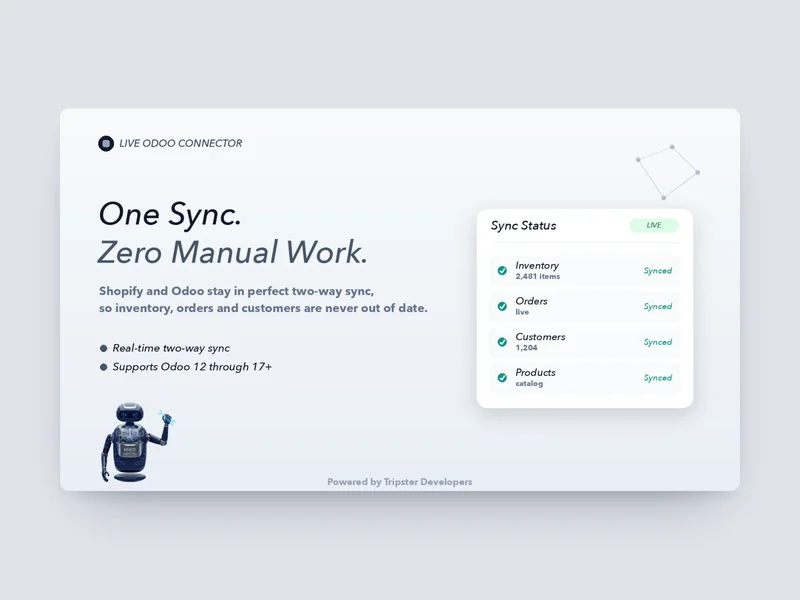
Odoo warehouse levels push to Shopify in real time, mapped across locations.

Shopify orders become Odoo sales orders, and tracking numbers flow back when you fulfil.

Customers, tags and purchase history stay in sync for support and marketing.
How it works
A short call to understand your Odoo version, warehouses and order flow.
We map products, units of measure, variants and fields, then install the connector.
Stock, orders and customers sync in real time, and we stay on hand for support.
Operations
Odoo warehouse levels are pushed to Shopify in real time. We handle multi-location stock mapping so your digital shelf always matches your physical one.
Orders flow instantly from Shopify to Odoo Sales Orders. Once fulfilled in Odoo, tracking numbers are pushed back to Shopify automatically.
Bi-directional sync of customer data, tags, and purchase history ensures your support and marketing teams have a single source of truth.
For Shopify Plus
Unlock the full power of Shopify Plus B2B. Our connector automates the complex relationships between Odoo Partners and Shopify Companies.

Engineering
Handle complex Units of Measure (UOM). We can map Odoo UOMs to Shopify variants, allowing you to sell by the piece, box, or pallet effortlessly.
Synchronize multi-dimensional variants. Whether it's size, color, or material, our connector maintains variant integrity across both platforms.
Sync technical specs, care instructions, or custom Odoo fields into Shopify Metafields for advanced frontend filtering and display.
Map Odoo virtual and physical warehouses to specific Shopify locations for intelligent local fulfillment and shipping cost reduction.

Zero-Failure Engineering
Enterprise integrations cannot fail. We built the Live Odoo Connector with defensive programming at its core.
Our middleware automatically detects failed sync attempts and retries with exponential backoff logic.
Real-time notifications via Slack or Email if stock discrepancies or API rate-limit thresholds are detected.
Custom Solutions
Standard connectors have limits. Our foundation is built to be extended. We build bespoke data transformations and synchronization rules that follow your brand's unique values and values.
Manage inventory priorities between retail, wholesale, and marketplace channels from one Odoo instance.
Automatically enrich Shopify product data with technical specifications or certifications stored in Odoo.

See It In Action
Products, inventory, orders and customers stay in step across Shopify and Odoo, in real time, both directions.
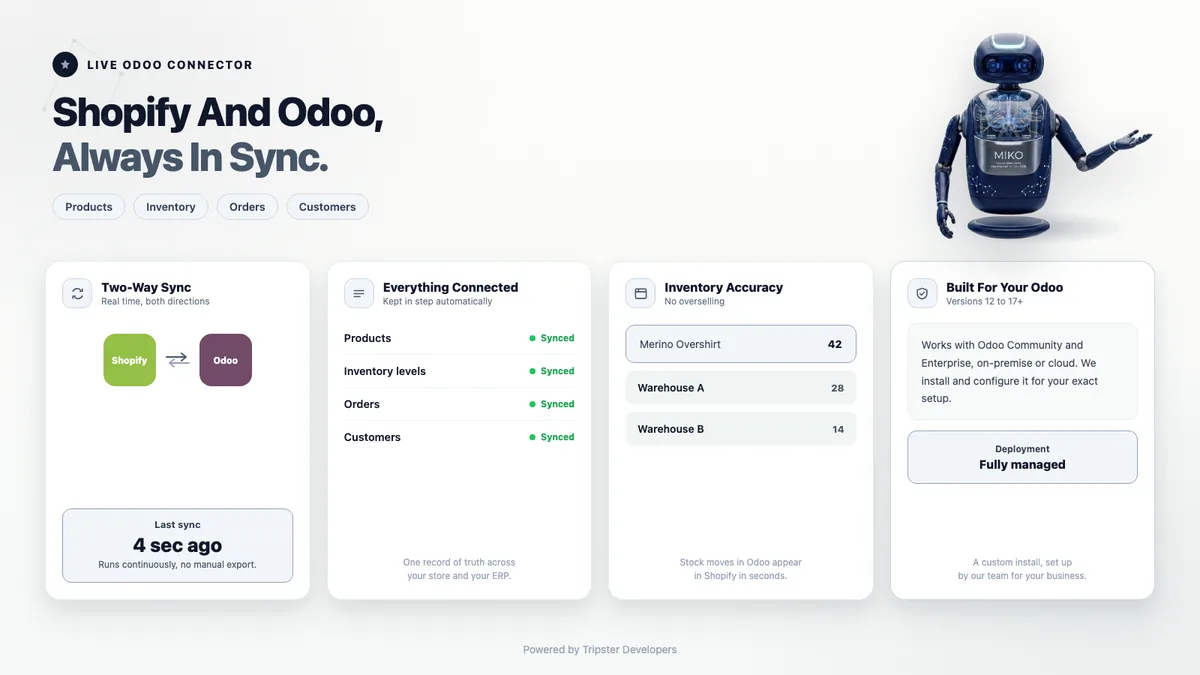
The Live Odoo Connector opens a real-time two-way link between your Shopify store and your Odoo database. Products, variants, inventory levels, orders and customers move in both directions on a webhook-driven queue, so a sale in Shopify decrements Odoo stock immediately and an Odoo stock adjustment reaches Shopify without a manual export.
Odoo v12 through v18, on Odoo Online, Odoo.sh and self-hosted installations. Because the connector talks to Odoo over its standard API rather than patching core, an Odoo upgrade does not require rebuilding the integration.
There are free and open-source modules on the Odoo Apps store, and they can work for a small catalog with simple requirements. Where they usually fail is variant mapping, partial refunds, multi-warehouse stock and silent sync failures that leave your two systems disagreeing. We are happy to tell you when a free module is genuinely enough for your setup.
Emipro and Webkul both ship capable, widely used modules. The practical difference is the delivery model: they sell you a module to configure yourself, while we install, map and test the integration against your actual data and stay responsible for it afterwards. If you already run their connector and it mostly works, we will say so rather than sell you a replacement.
Yes. The same sync architecture handles marketplace channels, so Odoo can act as the single stock and order record behind Shopify plus Amazon, eBay, Etsy, Walmart, TikTok Shop or a regional marketplace. Every extra channel is another consumer of the same inventory pool rather than another spreadsheet.
Yes. We build and maintain Odoo connectors for Magento 2, WooCommerce, BigCommerce and PrestaShop. Merchants running two storefronts on different platforms are common, and Odoo is usually the right place to hold the master catalog.
Odoo's own accounting can be the ledger, or we can bridge Odoo to QuickBooks or Xero so invoices and payments land where your accountant already works. Which is right depends on whether you want Odoo to own finance or to feed it.
Yes. We expose a read layer from Odoo for Power BI, Metabase, Looker or BigQuery so reporting does not run queries against your live operational database and slow it down.
Nothing is lost. Failed jobs stay on the queue with their payload, retry on a backoff schedule, and surface in a log with the record and reason attached. The failure mode we design against is silent drift, where two systems quietly disagree and nobody notices for a month.
Yes, and this is where most integrations break. Shopify variants and Odoo product templates with attribute values are different models, so we map them explicitly rather than matching on SKU alone. Variants added later in either system are picked up without a full re-import.
Yes. Odoo multi-warehouse maps to Shopify locations, so stock shows against the right location and fulfillment routes from the correct warehouse. Location-aware stock is one of the strongest reasons to run Odoo behind Shopify at all.
Yes. Shopify Plus B2B companies, locations, catalogs and price lists map onto Odoo partners and pricelists, so wholesale pricing is maintained in one place. We also build B2B on standard Shopify where Plus is not justified.
A standard build is two to four weeks: connection and authentication, then field mapping against your real data, then a parallel run before cutover. Heavily customized Odoo instances or large catalogs take longer, and we will tell you which you are before quoting. Our step-by-step guide to connecting Shopify to Odoo shows each stage.
No. Sync runs on a queue with rate limiting rather than firing synchronous writes on every event, and bulk operations are batched. Reporting is served from a read layer so dashboards never contend with operational writes.
Most merchants run both, because they do different jobs: Shopify is the storefront and checkout, Odoo is inventory, purchasing, manufacturing and accounting. If you genuinely want to consolidate onto one, we will map what you would lose before you commit.
They are not really competitors. Shopify's storefront, checkout and app ecosystem are far ahead of Odoo's website module for selling. Odoo is far ahead for stock, purchasing, manufacturing and accounting. The common answer is Shopify in front, Odoo behind, connected properly.
Yes. Most of our integration work is on Odoo instances built by someone else, including heavily customized ones. We start by reading what is actually there rather than assuming a standard install.
Tell us your Odoo version, how it is hosted, your catalog size and which systems need to talk. We come back with a fixed-price scope and a mapping plan. There is no charge for that conversation.
Our team provides full-service installation, mapping, and testing. Let's build a bridge that scales with your growth.
More apps we build and run
Every Miko app is built to the same App Store standard and maintained by the developers you would talk to on a project.
 Miko Loyalty & Rewards
Points, VIP tiers and referrals that bring shoppers back.
 Miko B2B Wholesale Pricing
Wholesale prices by customer tag, NET terms and POs.
 Miko Claude AI
Churn prediction, RFM segments and AI win-backs.
 AI Descriptions & Narrate
Bulk SEO copy in your voice, plus a Listen button.
 Miko Product Rentals
Date pickers, deposits and overbooking protection.
 Miko Subscribe & Save
Subscriptions and subscribe & save with a self-serve portal.
 Miko Restock: Inventory & PO
Know what to reorder, how much and when.
 Miko Bulk Image Resizer
Resize, compress and watermark every product photo.
 Authentica: COA Certificates
QR-verified Certificate of Authenticity for every order.
 Miko AI Help Center & FAQ
Help centre and FAQ pages written from your own store data.
Starting on Shopify?
Open your store on Shopify in a few minutes, try it with your own products, and bring us in when you are ready for design, migration, apps or integrations.