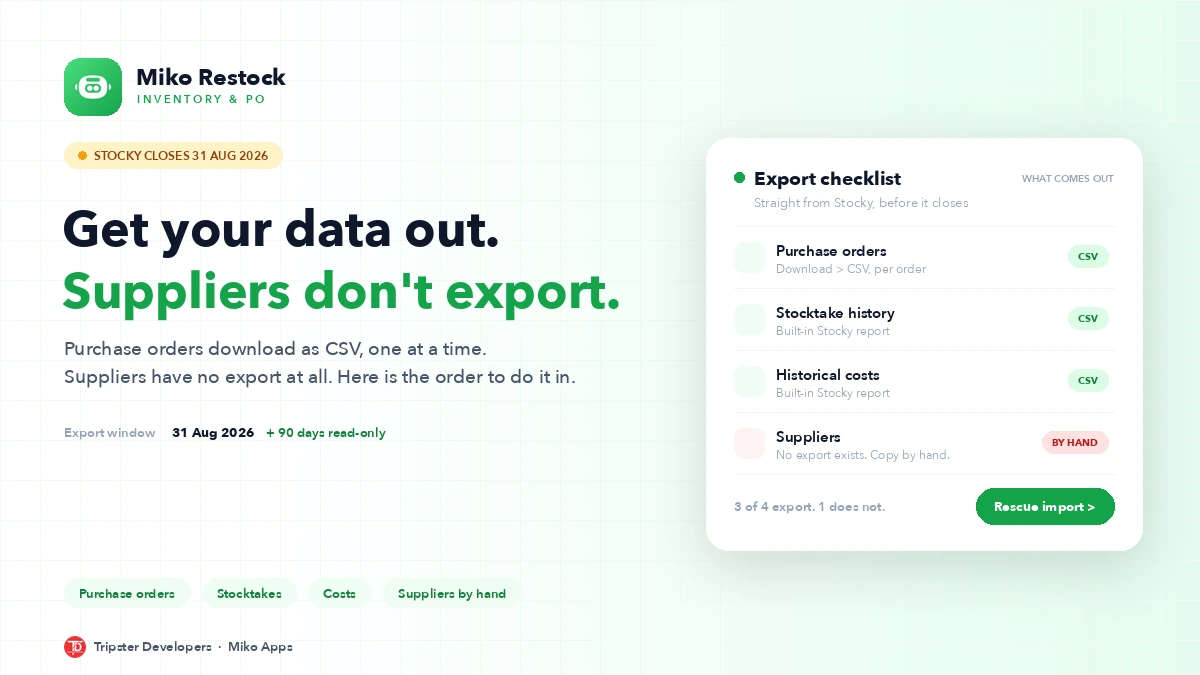
Export your Stocky data through Stocky's own reports before 31 August 2026. Purchase orders download individually from Apps → Stocky → Purchases → [PO number] → Download as CSV, and there is no bulk export. Suppliers cannot be exported at all and must be copied into a spreadsheet by hand. Shopify cannot import that history back in, so if you want it live again inside Shopify, an app such as Miko Restock: Inventory & PO reads the CSV and rebuilds it.
Most of the advice about Stocky right now is about where to move next. This guide is about the step before that: getting your data out while you still can. It matters more than it sounds, because Shopify has been clear that the history does not travel with you, and one category of data has no export button at all.
Everything below is drawn from Shopify's own migration guidance and its Stocky documentation, not from guesswork.
When is the deadline to export Stocky data?
Shopify's wording is unambiguous: Stocky will not be available after 31 August 2026. It was already pulled from the App Store on 2 February 2026, so no new merchant can install it.
There is one piece of good news that gets lost in the panic. Shopify has said merchants keep read-only access to export their data for at least 90 days after the shutdown date. The export window does not close on the 31st. That is breathing room, not permission to forget about it.
How do you export a purchase order from Stocky?
Purchase orders are the part people care most about, and the process is straightforward but tedious. Inside Stocky:
- Go to Apps, then Stocky, then Purchases.
- Click the purchase order number you want to keep.
- Choose Download, then pick your format: PDF, plain text, CSV, or CSV for Dymo.
Take the CSV. A PDF is fine for your own records but no other system can read it back in later. If you want a copy in your inbox as well, open the purchase order, choose Send, tick Attach CSV and email it to yourself.
The catch is that there is no bulk export for purchase orders. Each one downloads on its own. If you have run Stocky for years, budget real time for this, and work backwards from your most recent and most important suppliers rather than trying to get every historical record.
Beyond individual purchase orders, Stocky's built-in reports will give you completed purchase order reports in CSV, your stocktake history, and historical cost data. Those reports are the fastest way to capture the bulk of what you have.
What you cannot export from Stocky
This is the part that catches people out, and it is worth reading twice.
Suppliers cannot be exported from Stocky. Not as CSV, not as anything. Shopify states it plainly. There is no export function for supplier records, which means the only way to keep them is to open Stocky and copy the details into a spreadsheet manually while you still have access.
For most merchants this is the single highest-value hour they will spend before the deadline. Purchase order history is nice to have. Supplier contacts, lead times, costs and reorder preferences are what actually run your buying, and they are the hardest thing in the world to reconstruct from memory once the app is gone.
Why your export is an archive, not a migration
It is tempting to assume that exporting from Stocky and importing into Shopify will put you back where you started. It will not, and Shopify says so directly.
- Historical purchase orders cannot be imported into Shopify. The records come out; they do not go back in.
- Shopify's purchase order CSV upload cannot carry past statuses, received quantities, or supplier links. Even where an import exists, the parts that make history meaningful are dropped.
- Old purchase orders and stocktakes do not automatically move into Shopify. Nothing migrates on your behalf.
So the honest framing is this: your exports are an archive. They are a folder of files you can search when someone asks what you paid for something in 2024. They are not a working history inside your store.
How to keep your supplier and purchase order history live
If you want that history to be usable rather than archived, it has to go into something that can read it. That is the specific gap Miko Restock: Inventory & PO was built to close.
Its Stocky Rescue importer takes the CSV files you exported, plus the supplier spreadsheet you built by hand, and rebuilds your suppliers and purchase order history inside Shopify. Rather than starting from an empty app on 1 September, you start with your buying history intact. It runs on any Shopify plan, which matters because Stocky required POS Pro at $89 per month and locked out online-only sellers entirely.
If you are still deciding where to land, we have written a fuller comparison of the options in the best Stocky alternative for Shopify, including what Shopify Admin now covers natively and what it does not.
Your Stocky export checklist
In the order that protects you best:
- Copy your supplier list into a spreadsheet. There is no export. Do this first.
- Run Stocky's built-in reports for completed purchase orders, stocktake history and historical cost data, and save the CSVs.
- Download your most important purchase orders individually as CSV, working backwards from most recent.
- Stop creating new purchase orders in Stocky around 17 August 2026, roughly two weeks out.
- Receive and close every open or in-transit purchase order before 31 August 2026.
- Choose your replacement and import while the exports are fresh and you still remember what each file is.
The merchants who will have the smoothest September are the ones who treat the supplier spreadsheet as urgent and everything else as scheduled work.
Frequently asked questions
How do I export my Stocky data before it shuts down?
Use Stocky's own reports to export what you want to keep, then download your completed purchase orders individually. In Stocky, go to Apps, then Stocky, then Purchases, click a purchase order number, and choose Download. You can save it as PDF, plain text or CSV. There is no bulk export for purchase orders, so each one has to be downloaded on its own. Suppliers cannot be exported at all and must be copied into a spreadsheet by hand.
When is the deadline to export Stocky data?
Stocky will not be available after 31 August 2026. Shopify has said merchants keep read-only access to export their data for at least 90 days after that date, so the export window does not slam shut on the 31st. Even so, Shopify advises stopping new purchase orders in Stocky about 14 days before the deadline and closing any open or in-transit purchase orders first.
Can I export suppliers from Stocky?
No. Shopify states plainly that suppliers cannot be exported from Stocky. There is no export function for supplier records at all, so the only way to keep them is to copy the details into a spreadsheet manually while Stocky is still reachable. For most merchants this is the single most valuable thing to do before the deadline, because supplier contacts, lead times and costs are the hardest data to reconstruct.
Can I import my Stocky purchase order history back into Shopify?
Not into Shopify itself. Shopify is explicit that historical purchase orders cannot be imported, and that its purchase order CSV upload cannot bring across past statuses, received quantities or supplier links. Your exports are an archive rather than a migration. A third-party app can read those files, which is how Miko Restock rebuilds supplier and purchase order history inside Shopify.
What happens to my purchase orders on 31 August 2026?
Any purchase order still open or in transit in Stocky when it goes dark stops being trackable there. Shopify recommends receiving and closing all open purchase orders before the deadline so nothing is left mid-flight, and pausing new purchase orders in Stocky roughly two weeks out so you are not creating records you cannot finish.
What is the best format to export Stocky purchase orders in?
CSV. Stocky offers PDF, plain text, CSV and CSV for Dymo when you download a purchase order. PDF is readable but not machine-parseable, so a CSV is the only format another system can reliably import later. Export the purchase order CSV even if you also keep a PDF for your records.
Do not start September with an empty app
Export your suppliers and purchase orders now, then bring them back to life inside Shopify. Miko Restock: Inventory & PO reads your Stocky CSVs, rebuilds your supplier and purchase order history, and runs on any Shopify plan with a free tier.